
Aktuelle Themen


7. September 2026
ASME – BPVC

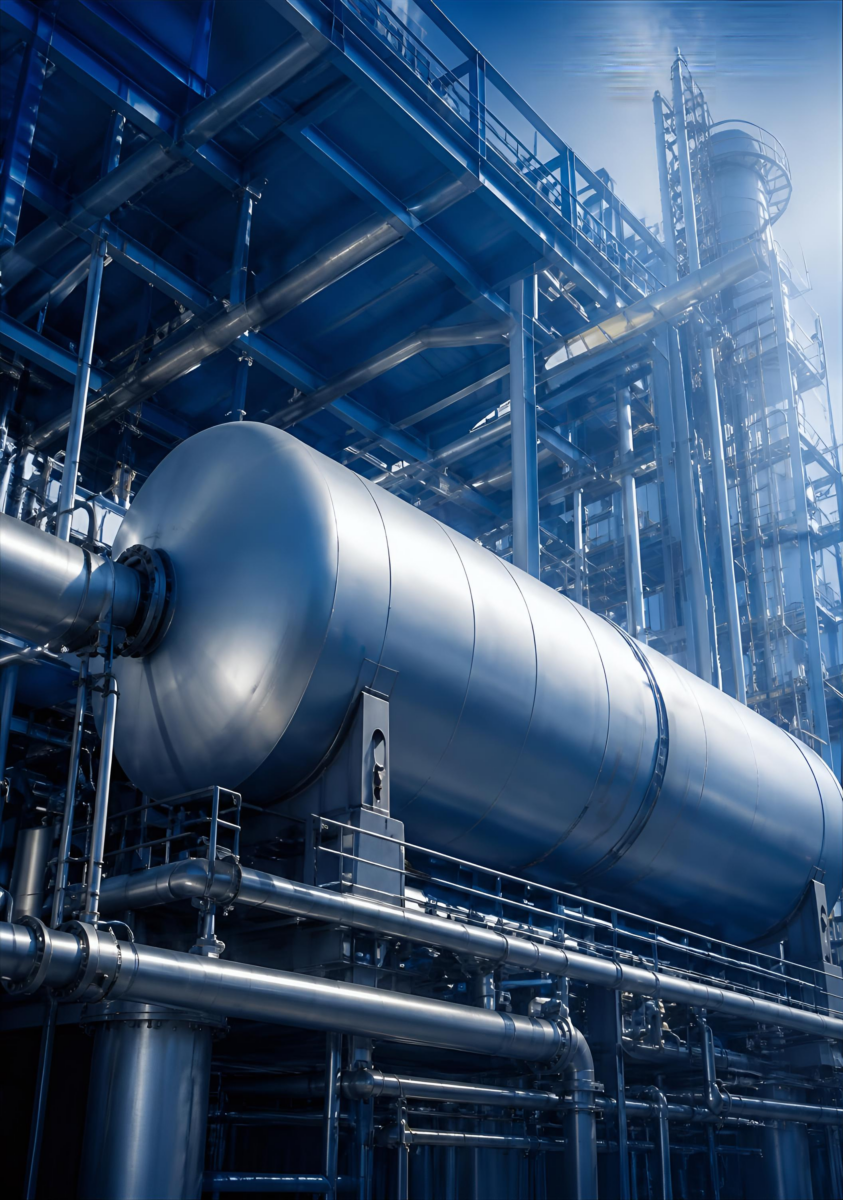
ASME Boiler and Pressure Vessel Code (Digital Edition)
What is the ASME Boiler and Pressure Vessel Code (BPVC)?
The ASME Boiler and Pressure Vessel Code (BPVC) is a set of technical standards published by the American Society of Mechanical Engineers (ASME). It specifies requirements for the design, manufacture, testing, and inspection of boilers, pressure vessels, and other pressure-bearing components. The Code helps companies implement technical requirements for the design and manufacture of such systems and components in a transparent manner.
The BPVC is divided into various sections that cover different technical areas. Which parts are relevant depends on the specific application and project. For companies that design or manufacture pressure vessels, ASME Section VIII is particularly important. It addresses the rules for the design of pressure vessels and includes, among other things, requirements for materials, fabrication, testing, and overpressure protection.
Therefore, not all of the BPVC is always relevant for practical work. Depending on the project, individual sections or editions may be required. Especially for existing facilities and older projects, the regulatory standards in effect at the time can also be decisive.
What does digital ASME BPVC access include?
With SAM-ASME, you receive licensed online access to ASME BPVC in digital format. The current edition, ASME BPVC 2025, as well as historical versions dating back to 2019, are available. This allows you to refer not only to current requirements but also to older versions of the code for existing projects or technical documentation.
All ASME NON-BPVC documents, in both historical and current versions, are also available.
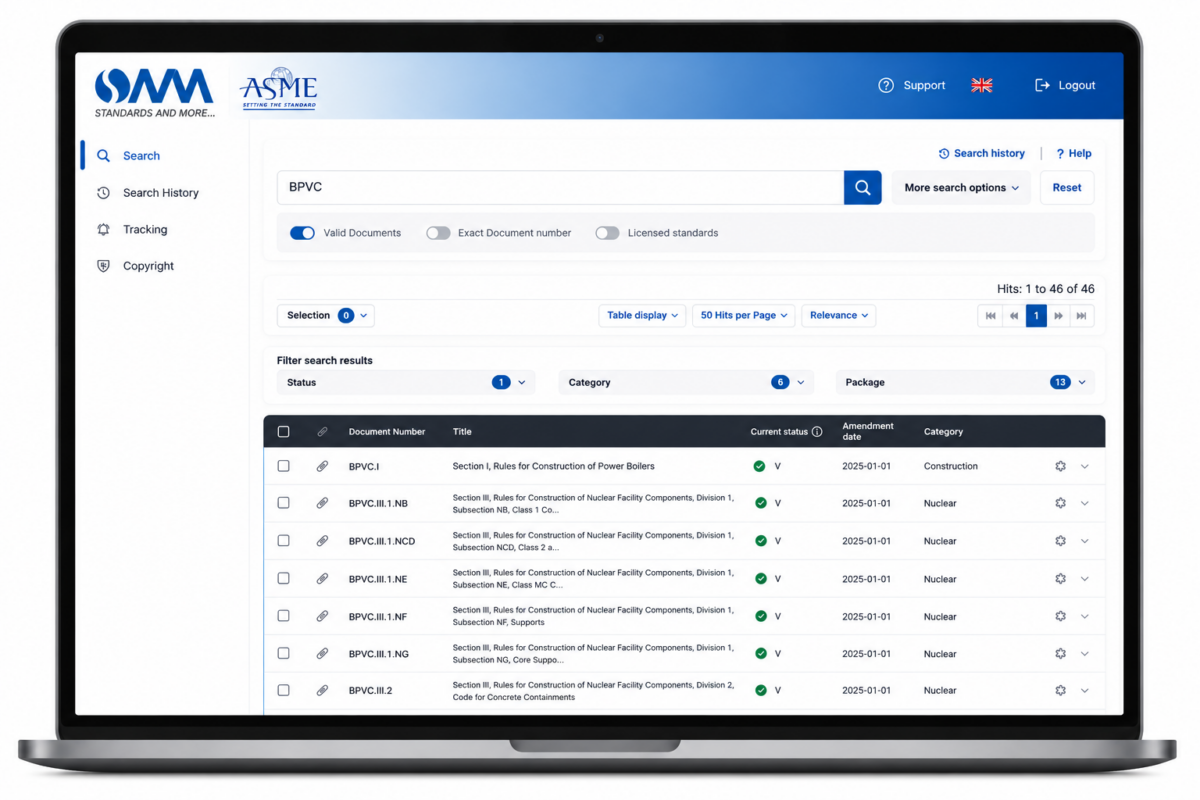
The content is available as digital packages as part of an ASME annual subscription. The full texts can be searched online, allowing you to easily find relevant requirements, sections, and technical specifications.
If necessary, you can also print content. Network support allows for use in organizations with multiple authorized users.
Which sections of the ASME BPVC are available in digital format?
Digital access via SAM-ASME provides access to the available content of the ASME Boiler and Pressure Vessel Code (BPVC). Depending on the package selected, the sections and editions relevant to the respective technical application area are available.
The content covers, among other things, requirements for design, materials, manufacturing, welding, testing, and inspection. The specific sections and divisions required depend on the individual project and its technical application.
The full-text search allows you to find specific relevant terms, requirements, and text passages. In addition to the current edition, ASME BPVC 2025, SAM-ASME provides access to historical versions dating back to 2019. This also allows you to review older projects, facilities, or technical documentation as needed.
SAM helps you select the right digital ASME offering and advises you on the available features.
What are the benefits of the ASME BPVC online?
The ASME BPVC online makes it easier to search and work with extensive technical codes on a daily basis.
- Quick Search: The full-text search allows you to find specific relevant terms and passages. This can be particularly helpful when you need to review technical requirements from different areas of the BPVC.
- Current and Historical Regulatory Standards: In addition to ASME BPVC 2025, historical versions dating back to 2019 are available. This allows companies to review earlier requirements as needed, such as for existing facilities or older projects.
- Centralized digital access: The required content is available online through the ASME Digital Library (https://www.standardsandmore.com/digitale-bibliotheken/asme/) and no longer needs to be managed exclusively through multiple printed volumes. This can be particularly convenient for technical departments that regularly access ASME content.
- More Flexible Use: Depending on the licensed offering, the content can be used by multiple authorized users within the organization. If necessary, the content can also be printed.
Digital access thus offers a convenient way to incorporate the ASME Boiler and Pressure Vessel Code into daily technical research without having to rely solely on printed editions.
Why purchase ASME BPVC through SAM-ASME?
With SAM-ASME, you gain digital access to ASME content through the SAM—Standards And More—platform. SAM helps companies select the right ASME offering and advises them on which content is relevant to their specific technical needs.
In addition to the ASME BPVC, SAM provides access to other digital technical resources for technical and industrial applications. These include, for example, ASME Press eBooks, which offer supplementary technical information on engineering and technology.
SAM also offers solutions for managing other technical regulations. With normI’s standards management feature, standards and internal specifications can be managed centrally.
You can find more digital resources here: An Overview of Digital Libraries.
Who is the digital ASME BPVC designed for?
The digital ASME BPVC is suitable for companies and technical departments that regularly work with the requirements of the code. It is particularly relevant for plant and machinery engineering, engineering, design, manufacturing, and quality assurance.
- Plant and Mechanical Engineering: Companies that design, manufacture, or document pressure vessels, boilers, or other pressure-bearing components.
- Engineering and Design: Professionals who take the BPVC requirements into account during technical planning and design.
- Manufacturing and Quality Assurance: Departments that must take into account or verify requirements regarding materials, manufacturing processes, welding, and inspections.
- Existing systems and older projects: Historical versions dating back to 2019 may be relevant when reviewing older technical documentation and projects.
Even companies operating internationally can benefit from digital access when working with customers, suppliers, or partners for whom ASME requirements are relevant.
How does digital access to the ASME BPVC work?
Digital access to the ASME BPVC begins with a request to SAM. During this process, we determine which ASME content and scope of use are required for your organization.
Based on this, SAM puts together the right digital solution. Interested companies can first try out the service through a no-obligation trial.
Once you have selected the desired offer, a license will be issued for the agreed-upon use. The specific sections, issues, and usage options included depend on the package you have selected.
What factors determine the cost of an ASME annual subscription?
The cost of an ASME annual subscription depends on the digital content selected and the intended scope of use. Therefore, the first step is to determine which sections of the ASME BPVC are needed.
The desired combination of current and historical issues, as well as the intended use within the organization, may also be relevant when selecting the appropriate package.
SAM will advise you on the available scope and, based on that, put together a suitable offer. This allows digital access to be tailored to your company’s actual information needs.
Timo Kandler

TRY IT OUT WITH NO OBLIGATION
Expand your technical knowledge and gain access to the world’s leading ASME Digital Collection and the comprehensive ASME standards. Take advantage of top-notch technical resources and stay at the forefront of your industry!
FAQs About ASME BPVC
The ASME Boiler and Pressure Vessel Code (BPVC) is a set of technical standards published by the American Society of Mechanical Engineers. It specifies requirements for the design, fabrication, testing, and inspection of boilers, pressure vessels, and other pressure-retaining components.
ASME Section VIII is particularly relevant for pressure vessels. It contains rules for the design of pressure vessels and covers, among other things, requirements for materials, fabrication, testing, and overpressure protection.
The current edition of ASME BPVC 2025 is available through SAM-ASME. In addition, historical editions dating back to 2019 are available. Of course, BPVC 2027 will be available through SAM-ASME.
Yes. Digital access enables full-text searches. This allows technical specialists to search specifically for terms and relevant requirements, rather than having to look up the necessary information exclusively in printed volumes.
Digital access is intended primarily for companies and technical departments in the plant engineering, mechanical engineering, and energy sectors, as well as for engineering, design, and quality assurance departments. The English-language version of the BPVC may also be relevant for companies operating internationally.
Test ASMe BPVC digitally using Sam-asme
Would you like to use the ASME BPVC digitally and see which plan is right for your company? Request a no-obligation trial account and see for yourself.
SAM helps you select the ASME content you need and advises you on the appropriate license scope. This allows you to determine which sections and editions are relevant to your technical fields.
Request a trial account now!
Articles about ASME
20. April 2026
ASME

ASME – International Technical Standards and Codes
What Is ASME? History, Goals, and Significance in Engineering
Founded in 1880 as the American Society of Mechanical Engineers, ASME is now a leading organization for engineering, education, professional development, and research in the engineering sciences, with over 120,000 members in 151 countries.
It operates one of the world’s largest technical publishing houses, organizes numerous annual conferences, and offers professional training and certification programs.

Areas of expertise: A wide range of technical disciplines
The standards of the American Society of Mechanical Engineers serve as a key reference framework for engineers worldwide. They cover a wide range of technical disciplines—from aerospace and biomedical engineering to energy and propulsion systems.
- Aerospace
- Bioengineering
- Communications, Networking, and Broadcasting
- Components, Circuits, Devices, and Systems
- Computing & Processing
- Engineered Materials, Dielectrics, and Plasma
- Engineering Profession
- Fields, Waves, and Electromagnetism
- General Topics for Engineers
- Earth Sciences
- Nuclear Science
- Photonics & Electro-optics
- Energy, Power, and Industrial Applications
- Robotics and Control Systems
- Signal Processing and Analysis
- Transportation
The ASME Codes – International Standards for Safety and Design
The ASME codes define requirements for materials, design, pressure rating, leak rates, inspections, and tests across a wide range of industrial sectors, from piping and pressure vessels to valves.
Overview of Important Technical Standards
ASME B16.5 – Flanges and Fittings
ASME B16.5 describes the requirements for flanges, spools, couplings, and fittings for use in pressure piping and other systems connected to various equipment. It also establishes material standards for flanges, spools, couplings, and fittings, including alloys, carbon steels, and stainless steels.
B16.5 regulates the dimensional profile for flanges, spools, couplings, and fittings, including their dimensions and tolerances. Furthermore, the standard describes pressure capacity and leak rate requirements for flanges, spools, couplings, and fittings.

B16.20 – Expansion Joints and Gaskets
ASME B16.20 specifies requirements for metallic gaskets used in pressure piping and flanged connections. The standard defines permissible materials—including alloys, carbon steels, and stainless steels—as well as dimensions and tolerances for ring gaskets, spiral-wound gaskets, and jacket gaskets. It also includes specifications for pressure resistance, leakage rates, and marking of these gasket types.
B31.3 – Process Piping in the Chemical and Petrochemical Industries
ASME B31.3 describes requirements for process piping used primarily in the petrochemical and chemical industries. It includes requirements for materials to be used in process piping, including carbon steels, stainless steels, alloys, and non-ferrous metals.
It also specifies design and fabrication requirements for process piping, including the selection of appropriate configurations, the selection of suitable welding procedures, and the supervision of welding operations. Requirements for pressure resistance and leak rates for process piping are also included.
ASME B31.3 describes requirements for inspections and tests of process piping, as well as the supervision of material testing, pressure testing, and final acceptance.
B31.1 – Power Plant Piping and Energy Systems
ASME B31.1 specifies requirements for power plant piping, including steam and condensate systems, heat transfer and cooling liquid systems, and oil and gas piping systems. It also specifies requirements for the materials to be used in power plant piping, including carbon steels, stainless steels, alloys, and non-ferrous metals. In addition to design and fabrication requirements for power plant piping, ASME B31.1 defines the selection of appropriate configurations, the selection of suitable welding procedures, and the supervision of welding operations. Requirements for the pressure capacity and leak rate of power plant piping are also standardized. Additionally, requirements for inspections and tests of power plant piping, as well as the supervision of material testing, pressure testing, and final acceptance, must be met.
B36.10 – Steel piping
The ASME B36.10 standard specifies requirements for steel piping used in the petrochemical and chemical industries.
B36.10 specifies requirements for materials to be used in steel piping, including carbon steels, stainless steels, and alloys. It also establishes design and manufacturing requirements for steel piping. These include the selection of an appropriate design, the selection of suitable welding procedures, and the supervision of welding operations. In this context, it also describes the specific requirements for pressure capacity and leakage rates for steel piping. Furthermore, the standard specifies the requirements for inspections and tests of steel piping. This includes the supervision of material testing, pressure testing, and final acceptance.
ASME Section VIII – Pressure Vessels
Section VIII is an important part of the American Society of Mechanical Engineers Boiler and Pressure Vessel Code (ASME BPVC). This section of Section VIII establishes rules for the design of pressure vessels. Of particular importance here are the requirements for the design, fabrication, testing, and inspection of pressure vessels. Section VIII also describes the tolerances that must be observed during the manufacture and use of pressure vessels, as well as the requirements for fabrication control and inspection.
Pressure vessels are used in a wide range of industrial applications, including the energy, oil, and gas industries, the chemical and petrochemical industries, and other industrial processes.
Note: ASME Section VIII is an important reference for anyone involved in the design, fabrication, testing, and inspection of pressure vessels to ensure that these vessels operate safely and reliably.
Zoltan Popp

TRY OUT NOW
Expand your technical knowledge and gain access to the world’s leading ASME Digital Collection and comprehensive ASME standards. Take advantage of top-notch technical resources and stay at the forefront of your industry!
ASME Digital Collection – Expertise for Engineers and Researchers
The Digital Collection is a comprehensive online platform for engineers, researchers, and students. It contains journals, conference papers, standards, and books covering all areas of mechanical and industrial engineering.
The content is searchable, filterable, and organized by topic to help users quickly find relevant technical information. The platform provides access to both current and historical issues, thereby supporting ongoing research and professional development in mechanical engineering and related disciplines.
ASME Standards Collection – The global standard for technical safety
The Standards Collection brings together all codes and standards, including the well-known ASME Boiler & Pressure Vessel Code. In addition, ASME is continuously expanding its range of publications—for example, with new journals such as:
ASME Letters in Dynamic Systems and Controls – shorter research articles published quickly
ASME Journal of Autonomous Vehicles and Systems – a journal focusing on autonomous vehicles and systems engineering
FAQ
ASME stands for the American Society of Mechanical Engineers. The organization develops technical standards, publishes technical literature, and promotes engineering education and research worldwide.
ASME codes establish mandatory safety and quality requirements for design, materials, testing, and inspections in industry. They are internationally recognized references for technical safety. Developed by experts from industry, academia, and standards bodies, they ensure that equipment and components meet the highest safety and performance standards. Through their global application, ASME codes promote the comparability of technical products, facilitate international trade, and play a crucial role in preventing accidents and system failures.
The ASME Digital Collection provides access to journals, conference proceedings, standards, and books. It helps engineers, researchers, and students quickly find and utilize the latest technical developments. In addition, it promotes the global exchange of knowledge and provides direct access to proven research findings and innovative technologies.
Gain access and expand your expertise!
Articles on ASME
2. March 2026
ASTM eBooks

e-Book Collection
ASTM eBooks – The latest technical expertise.
Add to your standards library with ASTM’s targeted eBook collections. Whether practical manuals or scientific research reports – we provide you with direct access to the expert knowledge behind the standards. SAM currently offers you access to over 1,550 current eBook titles.
ASTM eBooks- The perfect addition to your standards
Behind every ASTM standard is years of research and documentation. The ASTM eBooks make this knowledge available to you. As an official partner, SAM concentrates on putting together exactly the right eBook collections to support and safeguard your daily work with standards.
The collection includes specialized publication formats for every need:
- Selected Technical Papers: Benefit from peer-reviewed insights from ASTM symposia. Benefit from individual papers or complete edited volumes on current technical topics.
- Manuals: Get practical guidance and best practices from the world’s leading experts.
- Monographs: Deepen your knowledge with highly technical specialized information for complex challenges.
- Technical Reports: Direct access to data and recommendations from ASTM Technical Committees. Understand tomorrow’s research processes and trends.
- Data Series: The ultimate knowledge base. Access proven material properties and performance metrics to make informed design and production decisions.

Why buy ASTM eBooks via SAM?
In today’s world, time is the most important resource. SAM supports you in extracting the right information quickly and precisely from the huge amount of data from over 1,550 titles:
- Targeted curation: We help you select the packages that are truly relevant to your specific industry (e.g. construction, aviation or metallurgy).
- Platform expertise: We support you in using the latest digital delivery tools for seamless integration into your workflow.
- Central licensing: uncomplicated provision of content for individual teams of experts or your entire organization.
FOCUSED EXPERTISE FOR YOUR INDUSTRY
- Materials science: Everything about testing metals, plastics and innovative composite materials.
- Construction & engineering: From sustainable building materials to modern soil mechanics and infrastructure.
- Petroleum, Chemistry & Energy: The combined knowledge of ASTM committees on fuels, lubricants and new energies.
- Innovation & Aviation: Current reports on additive manufacturing (3D printing) and future-oriented high-performance materials.
Murat Alkan
+49 89 2 55 44 82 -0
E-mail to Murat Alkan

Discover & get started now!
Find the right ASTM eBooks for your requirements. We will advise you individually on the content and provide you with an up-to-date list of titles on request.
Articles on the subject of ASTM eBooks
2. March 2026
SAE eBooks
SAE e-Book Collection
Engineering excellence for the world of tomorrow.
Secure access to over 180 leading specialist publications on vehicle technology, aviation and drive systems. With SAM you receive customized e-book packages from SAE International – precise, practical and decisive for your development advantage.
SAE EBOOKS – PRACTICAL KNOWLEDGE FROM THE ARCHITECTS OF MOBILITY
The mobility transition requires more than just theory. SAE’s publications offer sound, practical information on the critical technologies and processes of our time. Written by experienced experts from industry and science, they provide precise analyses and comprehensible content.
Access includes a curated selection of titles – from Automated Driving (ADAS) to Sustainable Aviation Fuels. These works bridge the gap between academic research and market-ready applications and are an indispensable tool for engineers and developers worldwide.
EFFICIENT WORKING WITH THE SAE MOBILUS® COLLECTION
Choosing the right standards and reference books is crucial for your time-to-market. SAM supports you in optimally utilizing the enormous potential of the SAE Mobilus® platform for your goals:
- Precise licensing: Whether individual documents, thematically bundled collections or comprehensive packages – we analyze your needs and find the most cost-effective model for your institution.
- Platform expertise: We support you in the implementation and use of the SAE Mobilus® environment to guarantee seamless integration into your research workflows.
- Future-oriented curation: SAM bundles the latest titles for you on trends such as e-mobility, hydrogen drives and cybersecurity so that your team is always one step ahead technologically.
TOP TOPICS OF THE SAE EBOOK COLLECTION
- 1D and Multi-D Modeling Techniques for IC Engine Simulation, Second Edition
- Aerospace Engineering: Beginner’s Guide, Second Edition
- An Engineer in the Courtroom
- Beyond the Numbers: Managing the Assets of An Automobile Parts Business
- Business Reliability for DOE for Automotive Engineering: Vol 4
- History of Emissions
- Manufacturing Reliability for DOE for Automotive Engineering: Vol 3
- Motor Truck Engineering
- Problem and Solutions for Generalized Vehicle Dynamics
- Sustainable Aviation Fuels
- ABS, TCS, ESC, & ADAS – The Road to Autonomous Vehicles
- Mobility for ALL the World
- A Decade in Evolving Auto Mobility Software: Embracing Multipotentiality for Career Relevance
- Enabling Net Zero with Variable Compression Engines
- Automated Fiber Placement: Status, Challenges, and Evolution
Murat Alkan
Discover & get started now!
Whether you need individual titles or a complete SAE package – I can help you to efficiently bundle the right resources for your vehicle and aviation projects. Let’s work together to future-proof your library.
Articles on the subject of SAE Mobilus
2. March 2026
SPIE eBooks
SPIE e-books
Access the world’s largest collection of light-based technologies.
The SPIE eBooks Collection offers over 430 highly specialized titles ranging from the fundamentals of optics to cutting-edge photonics applications. With SAM, you license the resources that drive your research and development.
THE STRUCTURE OF THE SPIE PRESS LIBRARY
In order to meet the different requirements in research, teaching and practice, SPIE divides its publications into four established formats:
- Monographs: Comprehensive reference works and handbooks for in-depth scientific work.
- Tutorial Texts: Didactically prepared textbooks for getting started in new research areas.
- Field Guides: Compact, practical reference works with formulas and data for direct use in the laboratory.
- Spotlight eBooks: short digital tutorials that deal specifically with niche topics and new technology trends.
FOCAL POINTS OF THE DIGITAL LIBRARY
The collection covers all critical areas of modern optics. Particularly noteworthy are the leading publications in the following clusters:
- Optical design & lasers: laser systems, fiber optics and astronomical optics.
- Imaging & Biophotonics: Digital image processing, medical technology and remote sensing.
- Lithography & Nanotechnology: World-leading expertise in semiconductor manufacturing, nanophotonics and quantum technologies.
WORKING EFFICIENTLY WITH GAME EBOOKS
The integration of SPIE resources into your existing infrastructure requires strategic planning.
SAM supports you in this:
- Tailor-made license models: We advise you on which e-book package best suits your budget – from access to thematic collections to integration into the comprehensive SPIE Digital Library.
- Curated selection: We help you decide between individual titles, thematic collections or the perpetual access model.
- Workflow optimization: Advice on the seamless provision of content for your users to guarantee a smooth research process.
TOP TOPICS OF THE GAME E-BOOK COLLECTION
- Extreme Ultraviolet Lithography (2nd Edition): The definitive reference for the next generation of chip manufacturing.
- James Webb Space Telescope: Lessons Learned and Applications to Future Flagships – groundbreaking findings from modern astronomy.
- Optical Lithography for Advanced Semiconductor Patterning: Essential expertise for high-precision lithography processes.
- Computational Optical Imaging: Innovative approaches to digital image calculation and optical sensor technology.
- Optical Design of Eyewear Displays: Fundamentals and Design Strategies for Modern AR and Smart Glass Systems.
- Introduction to Microwave Photonics: The fusion of high-frequency technology and photonics for the communication of the future.
- The Vertically Integrated HgCdTe Photodiode: A disruptive architecture for state-of-the-art infrared detectors (FPA).
- A Master Optician’s Guide to Hand Grinding and Polishing: Precision craftsmanship for high-end optics production.
- Engineered Mediums: A comprehensive overview of artificial media and their applications in photonics.
Murat Alkan

Discover & get started now!
I support you in efficiently bundling the appropriate SPIE resources for your specialist area.
2. March 2026
IOP eBooks
e-Book Collection
Quantum leaps for your research.
Get direct access to the leading eBook collection of the Institute of Physics (IOP) – completely DRM-free and optimized for cutting-edge scientific research.
IOP EBOOKS – CUTTING-EDGE RESEARCH FOR PHYSICS AND ENGINEERING
The ongoing digital transformation demands precise answers in the fields of quantum technology, materials research and sustainable energy. The IOP eBooks™ Collection brings the combined knowledge of the world’s leading scientists directly to your workplace.
In cooperation with the Institute of Physics Publishing (IOPP), SAM offers you curated eBook packages that go far beyond traditional textbooks. The titles build the scientific bridge to the latest standards and are an indispensable tool for research, development and modern academic teaching.
WORK EFFICIENTLY WITH THE IOP EBOOK COLLECTION
The management of specialized physical and technical literature requires a clear structure. SAM helps you to make optimum use of the enormous depth of information in the IOP portfolio to achieve your goals:
- Future-oriented subject packages: Whether “Quantum Technology”, “Artificial Intelligence in Biomedicine” or “Renewable Power” – we help you to license the latest e-books specifically according to your actual research needs.
- Platform synergy & flexibility: Take advantage of the IOPscience environment with fully DRM-free content in PDF and EPUB format for maximum mobility and unrestricted access.
- Strategic consulting: SAM analyzes your inventory and bundles individual works or thematic series into cost-efficient overall solutions that are precisely tailored to your specialist department.
AVAILABLE EBOOK COLLECTIONS
- IOP Series in Advances in Optics, Photonics and Optoelectronics
- IOP Series in Artificial Intelligence in the Biomedical Sciences
- IOP Series in Coherent Sources, Quantum Fundamentals, and Applications
- IOP Series in Emerging Technologies in Optics and Photonics
- IOP Series in Global Health and Radiation Oncology
- IOP Series in Imaging Engineering
- IOP Series in Medical and Biological Image Analysis
- IOP Series in Next Generation Computing
- IOP Series in Nuclear Spectroscopy and Nuclear Structure
- IOP Series in Physics Education
- IOP Series in Plasma Physics
- IOP Series in Quantum Technology
- IOP Series in Renewable and Sustainable Power
- IOP Series in Sensors and Sensor Systems
- IOP Series in Spectroscopic Methods and Applications
- Series in Electromagnetics and Metamaterials
- Series in Micro- and Nano-metrology
- Series in Photomedicine and Biophotonics
- Series in Wave Phenomena in the Physical Sciences
Murat Alkan
Discover & get started now!
Explore our eBook collection and deepen your knowledge with the latest specialist content.
Articles on the topic IOP ebooks
2. March 2026
ASME Press
e-Book Collection
Technical knowledge available digitally – the e-books from ASME Press.
Use the ASME Digital Collection for direct access to the world’s leading technical literature. From classical mechanics to modern energy technology, ASME Press offers indispensable expert knowledge for research, development and teaching – digital, searchable and available at any time.
ASME Press- The gold standard in mechanical engineering
ASME Press is the specialized book publisher of the American Society of Mechanical Engineers (ASME). It was created to deepen technical knowledge beyond the pure standardization programs. The e-book collection forms the scientific bridge between theory and the practical application of international standards.
Today, the ASME Digital Collection includes over 200 current and classic e-books. The portfolio offers engineers and scientists in-depth insights into disciplines such as:
- Pressure Vessel Construction & Piping Technology (Pressure Vessels & Piping)
- Design & Manufacturing Technologies (Design & Manufacturing)
- Robotics & Mechatronics
- Energy technology, nuclear power & renewable energies
- Materials Science & Nanotechnology
Efficient working with the ASME Digital Collection
Digital provision enables companies and institutes to manage technical knowledge efficiently. The platform offers optimized functions for professional use:
- Full-text search: Quickly find formulas, data and best practices across the entire portfolio.
- Highly topical: New titles are published every year that reflect the latest technological trends and research findings.
- Central licensing: SAM advises you on the selection of suitable collections for your requirements.
Murat Alkan
Discover & get started now!
Explore the most important library for mechanical engineering and deepen your knowledge with the specialized content of ASME Press.
Contributions to the topic Asme press
2. March 2026
IEEE Xplore Digital Library
e-Book Collection
Precise specialist knowledge for the technologies of tomorrow.
Access over 7,600 high-quality eBook titles via the IEEE Xplore platform.
SAM offers you tailor-made specialist packages from the world’s leading technology publishers. Continuously expand your research with targeted collections for electrical engineering, computer science and related disciplines.
IEEE XPLORE EBOOKS – INNOVATIONS IN ELECTRICAL ENGINEERING AND COMPUTER SCIENCE
Fast access to verified specialist knowledge is the decisive factor for technological innovation today. As your specialized partner, SAM offers you direct access to the latest eBook frontlists from the world’s leading publishers within the IEEE Xplore platform.
These collections build the scientific bridge to the latest standards and provide in-depth insights into the groundbreaking developments in electrical engineering, computer science, artificial intelligence (AI) and cybersecurity. Rather than investing time in individual searches, these curated packages allow you to strategically build an inventory for your research institution or department.
WORKING EFFICIENTLY WITH THE IEEE EBOOK COLLECTION
Managing over 7,600 technical titles requires a clear structure. SAM helps you to make optimum use of the enormous depth of information in the IEEE Xplore environment to achieve your goals:
- Targeted needs analysis: We help you select the right collections (e.g. MIT Press, Wiley or Artech House) to license exactly the resources your team really needs.
- Central licensing: We bundle new releases and backfiles from various top publishers on a single, powerful interface.
- Up-to-date guarantee: Get immediate access to the most important technological publications of the current year.
AVAILABLE EBOOK COLLECTIONS
- Artech House eBooks Library
- De Gruyter AI & Data Science eBooks Library
- IEEE-Wiley eBooks Library
- Manning eBooks Library
- MIT Press eBooks Library
- Packt Business Software and Enterprise Technology eBooks Library
- Packs eBooks Library
- River Publishers SEM eBooks Library
- Princeton University Press eBooks Library
- River Publishers eBooks Library
- SAE eBooks Library
- Wiley AI eBooks Library
- Wiley Data and Cybersecurity eBooks Library
- Wiley Semiconductors eBooks Library
- Wiley Telecommunications eBooks Library
Murat Alkan
Discover & get started now!
Explore our eBook collection and deepen your knowledge with the latest specialist content.